
Last updated: Feb 2026
Version: Feb 2026
Owner: Chair
Approved by: Needs to be Board of Trustees
Review frequency: Annually (or sooner if required)
Safeguarding is everyone’s responsibility
Awareness of Safeguarding Concerns
What should a Member do with a safeguarding concern
What should a StopSO person do with a safeguarding concern
Seriousness and Imminency of Risk
Responding to information that a client has been a victim of abuse
Responding to information that a client presents a risk of harm to another person
Responding to information that a person is under police investigation for sexual offending
Responding to information that a client is at risk of self-harm or suicide
Making a disclosure to the Police or Local Authority
Making a disclosure to another third party
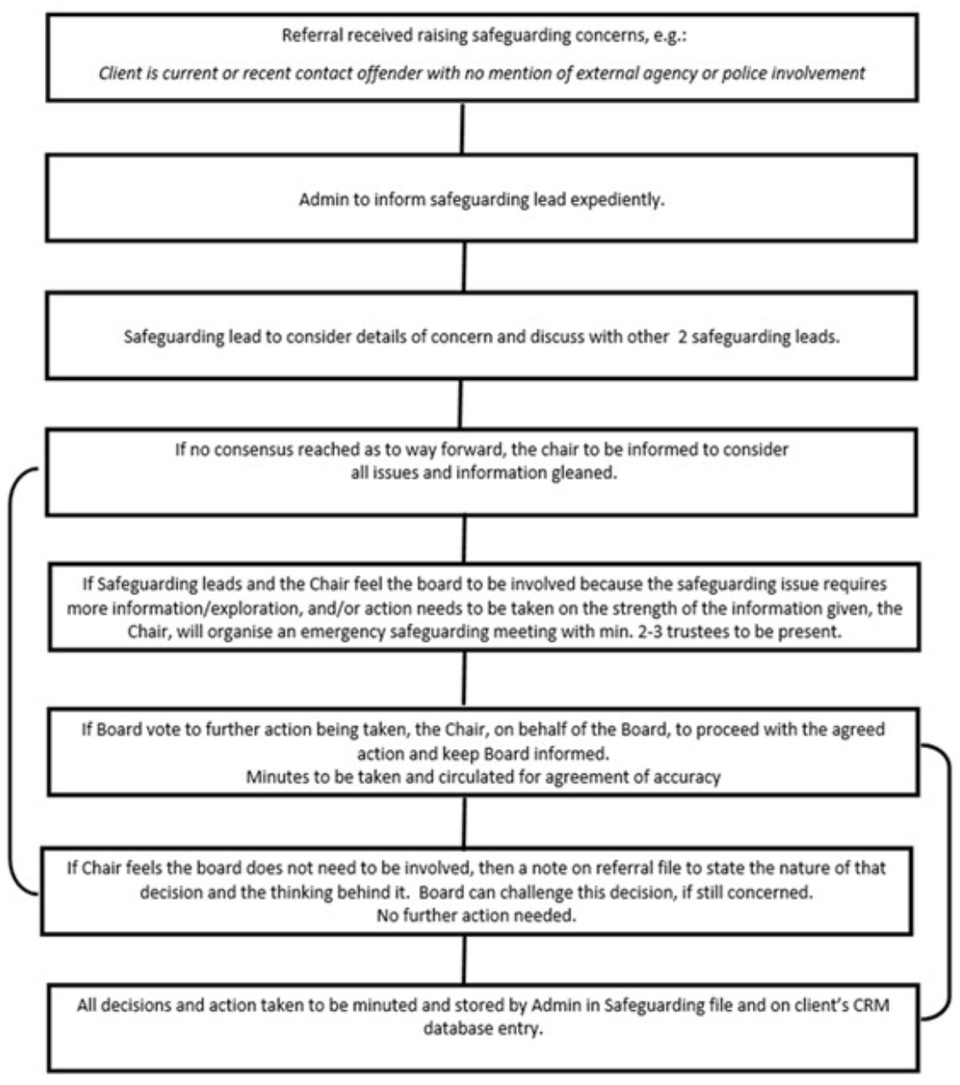
Appendix 1 – StopSO safeguarding flowchart
StopSO UK is the Specialist Therapy Organisation for Perpetrators and Survivors of Sexual Offending. We work with those at risk of turning thought into action.
StopSO receives enquiries from individuals and organisations in respect of persons seeking therapeutic support. This includes individuals who have engaged in risky or harmful sexual behaviours and those who have inappropriate, risky or harmful thoughts in respect of sexualised behaviours. StopSO members also work with survivors of sexual violence, partners and families.
Everyone working for or with StopSO should be aware of this policy. Safeguarding is at the heart of all we do. The purpose of the policy is to reduce harm, keep everyone safe, and support members in the delivery of their services.
This policy should be read in conjunction with the Disclosure Policy.
For the purposes of this document:
a child is defined as someone under 18 years of age;
a vulnerable adult is defined as someone who is over 18 years of age and is getting, or may need, help and services to live in the community. StopSO recognises that the term ‘vulnerable adult’ has a variety of different legal meanings and maybe understood differently in different contexts. StopSO takes a broad and inclusive approach, and makes no material distinction between ‘vulnerable adults’, ‘adults at risk’ or other semantics. The vast majority of adults working with StopSO therapists may be vulnerable or at risk in some respect given the nature of the therapeutic support. The vulnerability of the adult at risk is related to how they are able to make and exercise their own informed choices and to protect themselves from abuse, neglect and exploitation.
‘StopSO people’ or ‘StopSO person’ means those who work for StopSO, including employees, contractors, volunteers, trustees and board members.
‘Member’ means a professional with a current StopSO membership.
‘DSL’ means Designated Safeguarding Lead. StopSO uses a process involving 3 DSL’s and the chair of the board of trustees. References to ‘DSL’ are therefore a reference to this process.
StopSO may become aware of safeguarding concerns through a variety of processes:
The referral to StopSO may itself raise safeguarding concerns
StopSO may be made aware of safeguarding concerns through another organisation
A StopSO member working with a client may raise a safeguarding concern with a StopSO DSL or other StopSO person.
StopSO people and members will always seek to ensure that any therapy provided is safe and all reasonable safeguarding measures are considered.
Safeguarding is the responsibility of us all, all the time. Safeguarding concerns may arise in respect of clients, other children or vulnerable adults, or of members and StopSO people.
Most requests for therapy are received via an online form. The StopSO person handling that request will consider any safeguarding issues arising on the face of the information provided and will raise any concerns with the DSL, before making a referral to a member where appropriate.
StopSO may be made aware of a safeguarding concern from a member arising from their ongoing therapeutic process. Information may come directly to the DSL. If information comes to another StopSO person, the information must be passed immediately to the DSL.
The therapeutic process is delivered to clients by members. StopSO itself does not deliver any therapeutic services to clients.
An ongoing therapeutic process may lead to the therapist identifying safeguarding concerns. The therapist can raise safeguarding concerns with the StopSO DSL at any time, either to seek advice and support, or to information share.
However, the member will also have duties and responsibilities arising from their own position. The member will have their own professional regulation position to consider. They may have contractual obligations to consider, either towards their clients or towards an employer or other umbrella organisation. They should have their own safeguarding policy and procedures to consider.
StopSO supports its people and its members in safeguarding best practice through this policy and the DSL will always be willing to guide.
The StopSO DSL will always help and support a member with safeguarding concerns. The StopSO DSL, chair and board will always respect the views of the member and will always strive to reach consensus as to what if any safeguarding steps are necessary. However, members must be aware that the StopSO DSL, chair and board may have a duty under this policy to take necessary safeguarding steps directly if required, even if that decision is at odds with the views of the member.
It can be useful to think of 5 R’s:
Recognise - understand the signs and symptoms or potential abuse, harm and neglect. Safeguarding training helps. Recognising may come through disclosures made during the referral process or therapeutic process. These may be ‘red flags’ or they may be more subtle. If it doesn’t feel right – do something.
Respond - If you have a concern it is essential you respond appropriately and do not ignore the situation.
Report - Report to a DSL, supervisor or other appropriate support point. Confidentiality is important, so only share what is necessary with those in the safeguarding process, but privacy and confidentiality need never prevent effective safeguarding when necessary.
Record - the who, what, why, when and where of safeguarding. Take contemporaneous, comprehensive notes and records.
Refer – This may be the responsibility of the DSL or of the member, but if the necessary action is to tell the police or the local authority then it must be done.
If a safeguarding concern is detected by the member in the process of individual therapy (and it is not a risk of serious harm that is imminent – see relevant section) the member should consider what if any safeguarding mitigation steps might be available.
To seek a discussion with a StopSO supervisor. Consideration of guidance from a regulating body might assist. Contacting a StopSO DSL might be useful.
If a safeguarding concern is detected by a StopSO person the concern should be reported forthwith to the DSL.
Safeguarding concerns identified by a StopSO person in respect of a new referral that has not yet been referred to a therapist will be considered by the DSL before the client is referred to a therapist.
The information held by StopSO or the member will often be private and confidential.
However, privacy and confidentiality are very important and must be respected whenever it is possible to do so in a way that is consistent with safeguarding.
The main legal sources for the control of privacy and confidentiality in this area can be found in:
Common Law duty of confidence;
Human Rights Act 1998;
Data Protection Act 1998 and General Data Protection Regulation 2016.
Although some scenarios may require a more detailed consideration of these and other statutory provisions, the key message of this policy is that the law does not prevent the sharing of information when it is necessary and proportionate so as to address a serious safeguarding concern.
The starting point is the personal data and information, especially sensitive personal data, is to be kept private and confidential.
In the context of this policy, this means that reports and discussions about safeguarding should be anonymised wherever possible and consistent with the safeguarding concern raised. Everyone involved should be mindful of jigsaw identification. Take a need to know approach.
A client can always give consent to share their own otherwise private data. Safeguarding concerns will sometimes be so serious that a client’s consent is immaterial to a decision to share information.
In other cases, it will be appropriate or necessary to seek a client’s consent to share information. Many effective safeguarding steps can be discussed with a client and consent to share personal data will be necessary and appropriate.
No-one must promise to keep information private and confidential if that promise cannot be kept.
A person with parental responsibility can only consent to share information on behalf of a young person under the age of sixteen years if that young person does not have the capacity to understand the situation or make that decision.
If a StopSO person or member becomes aware of a risk of serious harm to a person and that risk is deemed imminent then immediate disclosure to the police and or social services must be considered. If other contact details are not available, call 101 to report the concerns.
This policy deliberately does not define either ‘serious harm’ or ‘imminent’. Each case must be considered on its own facts. However, a risk that a person will be a direct victim of a sexual offence will almost inevitably mean that they are at risk of serious harm. That risk will be imminent if the serious harm may arise before any other safeguarding measure is likely to be effective. Assessing risk, seriousness and imminency is a matter of judgement, using the best information available.
In most cases, even some urgent cases, passing information to the DSL and seeking advice and guidance will be appropriate before making a decision as to what, if any, safeguarding measure is appropriate.
Keeping good quality records of information is an important safeguarding principle.
Handwritten notes must be legible and as contemporaneous as possible. If making the notes contemporaneously is impossible then they should be made as soon as possible afterwards. Notes, records or log entries should be dated and timed.
Notes and Records should be:
Factual
Using the person’s own words where possible
A record of what you saw and heard
Contemporaneous
The DSL’s will store notes and records of safeguarding concerns in a confidential and secure manner.
StopSO will operate with 3 DSL’s, to ensure that sufficient safeguarding support is always available to the charity and to its members. The current DSL’s are members of the board.
Any StopSO person or member can contact any DSL at any time, directly, or by emailing: info@stopso.org.uk
It is the responsibility of the DSL’s individually and collectively, along with the chair, to ensure that there is an effective system in place to cover periods of absence, leave, illness or other unavailability.
The DSL receiving the safeguarding information will be able to consider the contents of concern, and share with each other the possible actions, advice or guidance.
Generally, if positive action is being considered by StopSO itself, all three leads, or as many are at that time available, will seek to agree on the action going forward. The chair of the board of trustees may be included in discussions where appropriate.
If, exceptionally, none of the DSL’s are available, the chair or other StopSO person may temporarily delegate the role of the DSL to another trustee.
All child protection safeguarding concerns must also be reported by a DSL to the chair.
The DSL should prepare an annual report for the board as to the effectiveness of this policy, including any recommendations for learning or development.
Some StopSO members, who are appropriately qualified and trained may delivery therapeutic services directly to children. This is highly valuable and important work. For the purposes of this work, we refer to children as those under the age of 18 years.
StopSO members working with children will ensure they have effective procedures in respect of:
Relevant and appropriate training, that is child centred, trauma informed and holds safeguarding and child protection at the forefront.
Appropriate and timely risk assessments and contracts to set out the expectations of the work and ensure the child knows what information will be shared and with whom. Any therapy-based contract and risk assessment should complement statutory risk assessments completed and held by the agencies working with the child. For example, a local authority social worker, or youth justice worker.
Responding compassionately and appropriately to complaints and allegations of abuse, in line with guidance such as Working Together to Safeguard Children 2023 and the child’s Local Authority Practice Procedures.
Appropriate supervision, with a supervisor who is familiar with the safeguarding and protection of children.
Having adequate insurance cover for any activity with children and young people.
Regularly reviewing, monitoring and, where appropriate, updating these procedures where appropriate.
Many clients who work with StopSO therapists have been victims of sexual, physical or psychological abuse. This need not be a safeguarding concern of itself. However, if a client is presenting as being in imminent danger of serious harm from new or further abuse, safeguarding concerns will certainly arise. Even relatively minor incidents may be serious if properly understood in their context.
If this scenario arises at the point of StopSO receiving a referral request, the StopSO person should refer the matter to the DSL process immediately. Consideration will be given to urgent safeguarding steps, including where appropriate reporting the matter to the police or local authority. Communication with the referral will be considered although often no promise of confidentiality can be offered.
If this scenario arises during the therapeutic process the member must follow their own safeguarding policy and any other relevant safeguarding policy, including this policy. They may seek advice and support from any of; their supervisor, the StopSO DSL, regulating body, legal advice, insurer.
In any event, an allegation of abuse or neglect may lead to a criminal investigation so nothing must be done which may jeopardise a police investigation, such as asking leading questions or attempting to investigate the allegations. Good quality note and record keeping is especially important. Do not promise confidentiality if you cannot keep that promise.
Many StopSO clients present as having engaged in harmful, risky or illegal thought or behaviour. These scenarios are likely to give rise to safeguarding concerns at some level, and will require consideration of what, if any safeguarding steps are necessary.
An imminent risk of serious harm will require consideration of disclosure to the police or the local authority.
If this scenario arises at the point of StopSO receiving a referral request, the StopSO person may refer the matter to the DSL process immediately. Consideration will be given to urgent safeguarding steps, including where appropriate reporting the matter to the police or local authority.
If this scenario arises during the therapeutic process the member must follow their own safeguarding policy and any other relevant safeguarding policy, including this policy. They may seek advice and support from any of; their supervisor, the StopSO DSL, regulating body, legal advice, insurer.
StopSO members support many individuals who are under police investigation. The fact that a client has committed or is alleged to have committed a sexual offence is not necessarily of itself a safeguarding concern.
In such cases the StopSO member should be especially alive to any safeguarding concerns that might arise in the context of the Criminal Justice Process. Examples include the risk of self-harm or suicide (especially at key milestones); the need to safeguard others in the event the client is incarcerated; the risk to others if a client presents in breach of bail conditions or protective orders; the risks of homelessness; the risks associated with substance misuse; the risks of further offending.
The fact that a person is accused of committing sexual offence is a relevant factor when considering safeguarding, but it is especially important not to make assumptions. Some clients will be innocent of the accusations but will still be seeking therapeutic support. Some clients will be innocent of the accusations but will have committed other offences. Some clients will have committed the offences alleged.
Being under police investigation or subject to protective orders can be a very important protective factor.
Information that a client is continuing to offend raises very important safeguarding concerns. If this information comes to a StopSO person they must immediately report the information to the DSL. If this information comes to a member this policy gives the strongest possible encouragement to the member to discuss the matter immediately with a supervisor and otherwise follow any relevant safeguarding policy and guidelines, including this policy.
Online offending is no less serious than in-person offending and seeking to distinguish between online and contact offending is not considered helpful.
Distinguishing cases on the basis of whether there is an identifiable, known victim is not considered helpful.
Each case must be considered on its own facts and circumstances.
A StopSO person must be aware to concerns and pass information to a DSL accordingly.
If this scenario arises during the therapeutic process the member must follow their own safeguarding policy and any other relevant safeguarding policy, including this policy. They may seek advice and support from any of their StopSO supervisor, the StopSO DSL, regulating body, legal advice, insurer.
Sometime the necessary safeguarding step is to make a referral to the police or local authority.
Whether such a referral should be made to the police, the local authority or other statutory agency is a matter of judgement for the DSL or member. Common sense must prevail as to which agency and by what method..
Reports to the police will usually be made by:
Calling 101 and providing information over the phone
Call 999 in cases where there is a danger to life or where criminal conduct is likely to be serious and in progress
Contacting the Officer in the Case of an existing investigation
Reports to the Local Authority will usually be to the social care team at the local authority where the victim is currently living.
However the report is made, a good quality record should be kept of what was reported, when and by whom. Online referrals should be followed up if not acknowledged, usually within 24 hours or sooner depending on the circumstances.
Some safeguarding steps involve making disclosures to other third parties. This policy does not attempt to be exhaustive or prescriptive about who can be told what or when, because each case requires its own consideration. Examples might include making a disclosure to another professional, such as a doctor or a lawyer. It might involve disclosure to a family member or friend. It might involve disclosure during a muti-agency working arrangement.
In any event, the principles of safeguarding as outlined in this policy continue to apply, especially regarding confidentiality, record keeping and timeliness.
Supervision is required for all therapist members with a StopSO supervisor, Supervision is an important part of effective safeguarding. All aspects of safeguarding should be discussed with the supervisor, to help keep emotive issues raised in perspective and to provide support.
If the therapist does not receive sufficient referrals to warrant a specialist supervisor, attendance at the StopSO peer supervision groups is encouraged. Supervisors also offer an ad hoc arrangement to encourage a flexible approach to professional guidance and support. The supervision sessions should be based on an agreed structure that should include formative aspects (developing the therapist); restorative aspects (helping them deal with the personal impact of the work) and normative aspects (ensuring that they are working to agreed standards).
All therapists, volunteers and trustees are responsible for their DBS checks. All trustees must provide an up to date DBS check. Members can apply for Enhanced DBS certificates via info@stopso.org.uk
StopSO DSL’s, Trustees and all members have free access to legal guidance from solicitors. This should be sought at any point to clarify expectations and to receive measured advice regarding legal and ethical considerations:
This is provided by: Stone King Solicitors
Contact: stopso@stoneking.co.uk or Matthew Graham (mag@stoneking.co.uk 07779 227261)
A member may also benefit from support through their insurer or regulator, and should be familiar with the routes to access advice and support.
Each member is encouraged to keep a central record of contact numbers and email addresses for support points, including those in this policy. Safeguarding decisions never have to be taken alone but are sometimes very urgent. Know who you will call if you need to.
STOPSO SAFEGUARDING FLOW CHART
This site uses cookies that enable us to make improvements, provide relevant content, and for analytics purposes. For more details, see our Cookie Policy. By clicking Accept, you consent to our use of cookies.